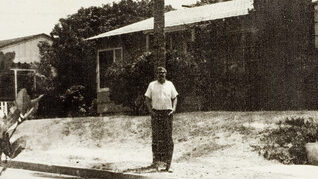
Only today did I come across this letter by Philip K. Dick, published in the excellent Letters of Note last September, addressed to the production company for Blade Runner. He loved how the film was developing, but died before it was actually released.
I came to the conclusion that this indeed is not science fiction; it is not fantasy; it is exactly what Harrison [Ford] said: futurism. The impact of BLADE RUNNER is simply going to be overwhelming, both on the public and on creative people — and, I believe, on science fiction as a field. Since I have been writing and selling science fiction works for thirty years, this is a matter of some importance to me. In all candor I must say that our field has gradually and steadily been deteriorating for the last few years. Nothing that we have done, individually or collectively, matches BLADE RUNNER. This is not escapism; it is super realism, so gritty and detailed and authentic and goddam convincing that, well, after the segment I found my normal present-day “reality” pallid by comparison.
Link
This photo from the Abramović opening is kind of touching. Her performance in the MoMA atrium is not supposed to include any interaction with those who sit across from her.

The caption from the Facebook album reads:
Ulay, Marina Abramović’s partner from 1975-1988, sits with her during her performance. This was the first time they “performed” together since The Great Wall Walk (1988), when they each walked over 1,200 miles (2,000 km) along the Great Wall of China starting at opposite ends and meeting in the middle to say their goodbye.
Somebody in the comments asks the obvious: “I thought there was to be no interaction with the art.” To which the moderator responds: “Correct, no interaction, but this was her partner in life and art for 12 years who she has had almost no contact with since 1988…”
Facebook link
George Lois on the first cover he art directed for Esquire:
Hayes mentioned that we were going to have a spread of Floyd Patterson, the boxing champion of the world, and Sonny Liston, the challenger, and Patterson was an 8–1 favorite. I knew right away what I was going to do, because I knew that Liston was going to kill him. So I called the photographer, and I said, “We’re going to get a guy with the same body as Patterson, we’re going to lay him flat on the ring, and we’re going to show him killed, knocked out by Liston. Leave him for dead.” I wanted to show a metaphor for boxing — if you’re a loser, you’re left for dead, which is also a metaphor for life. So we get the shot and I sent it to Hayes.

“George, I never saw a cover like this in my life! You’re calling the fight — suppose you’re wrong? Everybody says you’re wrong.” I told him we had a 50/50 chance of it working, but if it does, it shows we have balls. It hit the newsstand a week before the fight, and it was roundly laughed at in the sports crowd. But a week later, of course Liston kills Patterson, just like I thought. And Esquire got tons of publicity and the best sales since the start of the magazine. And Harold said to me, “You gotta keep doing my covers.”
He went on to create 92 iconic covers during the 1960s that were exhibited at MoMA and added to the permanent collection. Unfortunately only five of the covers have their image rights cleared to display online. Not many people realize that even if a work is “owned” by the museum, having the right to display it online is another matter. This is an issue the Brooklyn Museum has addressed nicely on their blog. This is why photography is usually not allowed in museums, except within the older permanent collections.
Link via Jason Kottke
Douglas Rushkoff is hosting a virtual round table with danah boyd, Nicholas Carr, Clay Shirky, RU Sirius and a bunch of other smart folks. It’s a chaotic mix of academic hyperbole and hastily typed rhetoric, but somehow it keeps me checking in for new entries. You may find that subscribing to the RSS feed is an easier way to read this since new content doesn’t always appear at the bottom. The first part is mostly about Nicholas Carr arguing with everyone else about whether groups can collectively “have an idea.” Carr says they can’t:
I think one of the reasons we’re having trouble discussing the way brilliant new ideas emerge from “networked ‘mass’ groups” is because that phenomenon doesn’t happen. The ideas for Wikipedia and Linux, to take, once again, the obvious examples, came from individuals, not from the groups that subsequently formed to bring the ideas to fruition. As Eric Raymond, the author of “The Cathedral and the Bazaar,” once wrote in an email to me, “The individual wizard is where successful bazaar projects generally start.”
Link
Marina Abramović is having a retrospective here at MoMA. It’s the first time a performance artist has had such a show, which will include reenactments of her pieces by other performers. The main event is a new endurance piece:
Marina Abramović will perform in the Atrium at MoMA throughout the
duration of the exhibition, starting before the Museum opens each day
and continuing until after it closes.
The New Yorker has an article (subscriber-only) on the exhibition that I haven’t read yet. There’s also a podcast interview with Judith Thurman, who wrote the article, that provides some useful context.
Link
Oh man, I can’t believe it’s been a whole year!
It was one year ago tomorrow that we launched the latest redesign of MoMA.org. (March 6 is a day that will be forever ingrained in the Digital Media team’s memory!) But MoMA has had an online presence for fifteen years now, since 1995, when an exhibition site for the design show Mutant Materials in Contemporary Design was developed. The following year, the Museum’s website, MoMA.org, officially launched, and we’ve been doing exhibition feature sites ever since.
One year ago I was working remotely from Groningen, NL where Ellie was doing a study abroad program. The weeks leading up to launch day were pretty brutal, probably my most intense working process since college. It seems so absurd, in retrospect, that most of it went down for me in that sleepy Dutch college town. Happy birthday MoMA.org! It was worth it.
Link
I just got my first email from The Ebert Club and realized I forgot to link to it here. Roger Ebert says:
I want to make some money from the web. It may appear that I have an enormously successful web site here. I do. But I’m not making any money. In the years since the site began, my share of the profits has come to a pauper’s penny. The Far-Flung Correspondents aren’t the only ones here working for free. To be sure, the Sun-Times pays me handsomely, although less handsomely since we all went through a “belt-tightening,” so as not to lose our pants.
He goes on to discuss Negroponte’s micropayment future that never came to pass. It’s a simple problem that has evaded that particular simple solution:
The web that we surf every day is not paying for itself, and we sure as hell aren’t paying for it. You read me for free, and I read everybody else for free. This is not news.
If you like Ebert’s writing, or even if you’re not very familiar with it, read more about The Ebert Club and consider sending him five bucks.
Link (See also)
From the excellent pictures for sad children, a tragic gaming story. After reading the comic, go play You Have To Burn The Rope. Can you feel the sorrow of Grinning Colossus right before he disappears in a puff?
Link
Filed in 2007, Patent Acquisition and Assertion by a (Non-Inventor) First Party Against a Second Party:
Methods for a first party to acquire and assert a patent property against a second party are disclosed. The methods include obtaining an equity interest in the patent property. The methods further include writing a claim within the scope of the patent property. The claim is written to cover a product of the second party where the product includes a secret aspect. The methods further include filing the claim with a patent office.
Alas, my prior art has been one-upped by a comically evil corporation.
Link via Doron
Apparently he revealed his new voice during an Oprah taping. His wife Chaz is hearing it for the first time in this video clip. It’s heartwarming and the guy is obviously very brave for going this route, but it also feels to me like an intrusion on their private moment.
Link
David Chancellor got 3rd place in the People in the News category from the World Press Photo awards.
Local villagers fall upon the body of a dead elephant, starved of meat they reduce the huge carcass to bones in under 2 hours.
24 hours later the bones have also gone, all that’s visible are the fresh tracks from the remaining elephants returning to Mozambique under cover of darkness.
Link
Well, kind of, thanks to a company that custom builds text-to-speech voices. Ebert’s new voice is compiled from his vast accumulated archive of reviews and commentary tracks.
CereProc didn’t need to hear me speaking a specific word in order for my “voice” to say it. They needed lots of words to determine the general idea of how I might say a word. They transcribed and programmed and tweaked and fiddled, and early this February, sent me the files for a beta version of my voice. I played it for Chaz, and she said, yes, she could tell it was me. For one thing it knew exactly how I said “I.”
CereProc is now blending in my audio snippets for “Casablanca,” where I sound enthusiastic, and “Floating Weeds,” where I sound calm and respectful. It’s nice to think of all these great movies sloshing around and coming out as my voice.
Link (See also)
Franklin Gothic is the basis of MoMA’s typographic identity. August Hefner found some examples of Franklin Gothic being used at the museum dating back to the 1930s. One of the signs reads:
The public is urgently requested to visit the Galleries in the morning, from 10 to 12 and evening from 8 to 10 in order to avoid congesting the elevator service. If this request is complied with, it will not be necessary to charge admission.
I didn’t realize that the museum’s adaptation of the typeface, MoMA Gothic, was created by the same type designer as the original.
Link
Patrick Winston is a professor at Harvard who gave a great lecture on how to give a great lecture.
He emphasizes how to start a lecture, cycling in on the material, using verbal punctuation to indicate transitions, describing “near misses” that strengthen the intended concept, and asking questions. He also talks about using the blackboard, overhead projections, props, and “how to stop.”
I was reminded of this after seeing some 404 errors in my server logs to a podcast version of the videos I put together, but forgot to transfer to my new server. To download these into iTunes (and onto your video-enabled iPod), go to the Advanced menu, choose Subscribe to Podcast and enter: http://phiffer.org/etc/how-to-speak.xml
Link (See also)