-
How to Vote / Cómo Votar
A print-at-home zine about overcoming barriers to voting in the United States. It’s validating to see ACLU.org cited as a resource for good voting info, since I helped build an earlier version of ACLU’s voter guide back in 2019.
Via Jessamyn West.
-
Powers of Ten
I watched the Eames’s Powers of Ten with my kids tonight. What a marvel of explanatory filmmaking. It’s hard to imagine packing much more into 9 compact minutes!
-
This is the work of our lifetime
Ayana Elizabeth Johnson on NPR’s All Things Considered:
I encourage people to think about what is at the intersection of those three circles for them. What are you good at? What work needs doing? And what brings you joy? … The thing that’s been keeping me up, literally last night, was reading about the climate impact of the tech industry and thinking about the new data out of Bloomberg that just building out the data centers that are planned will increase greenhouse gas emissions from the electricity center by 20- to 30% at a time we need to be rapidly decreasing.
Via her newsletter, via Bill McKibben‘s newsletter.
-
RIP John Baldessari
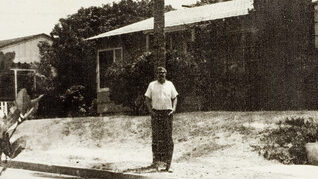
A small collection of artworks by John Baldessari, an amazing artist who died yesterday. If you’re unfamiliar with his work, A Brief History of John Baldessari is worth watching too.
Read more → -
RIP Joe Frank
One of the great radio voices is gone. This is from Time- Old from a collection of Hearing Voices on PRX.
If billions of years preceded our existence on Earth, billions of years will surely follow after our existence as well. So that our life here is like one flash of a strobe light. The wink of an eye. And if your life is merely a microscopic blip in the vast dimension of time, is its importance to you just an illusion?
Also worth a listen: Dreamers on Unfictional.
-
Grid Corrections
Grid Corrections shows, as Curt Meine puts it, “places where theory and reality meet.” Geoff Manaugh, writing for Travel + Leisure:
De Ruijter soon learned that these kinks and deviations were more than local design quirks. They are grid corrections, as he refers to them in a new photographic project: places where North American roads deviate from their otherwise logical grid lines in order to account for the curvature of the Earth. You could drive out there your whole life, de Ruijter realized, and not realize that certain stop signs and intersections exist not because of eccentric real estate deals, but because they are mathematical devices used to help planners wrap a rectilinear planning scheme onto the surface of a spherical planet. In order to avoid large-scale distortion, the Jeffersonian grid—shorthand for the founding father’s 18th-century geometric vision of six-square-mile township parcels, intended to guarantee equal and democratic land-distribution nationwide—is occasionally forced to go askew.
-
Neil Freeman interviewed about his Electoral College Reform map
You may have seen Neil’s map before, where each of the US’s 50 states are redrawn to balance for population. It’s nice to see his project’s motivating ideas laid out like they are in this Paris Review interview:
I think that the biggest cultural change would be with the profusion of city-states. Many states overrepresent rural areas when it comes to divvying up funding for infrastructure projects and other spending. The alignment of metro areas and states would mean that decision-making power in land use and transportation would shift away from rural areas, which would probably mean less sprawl and more livable cities.
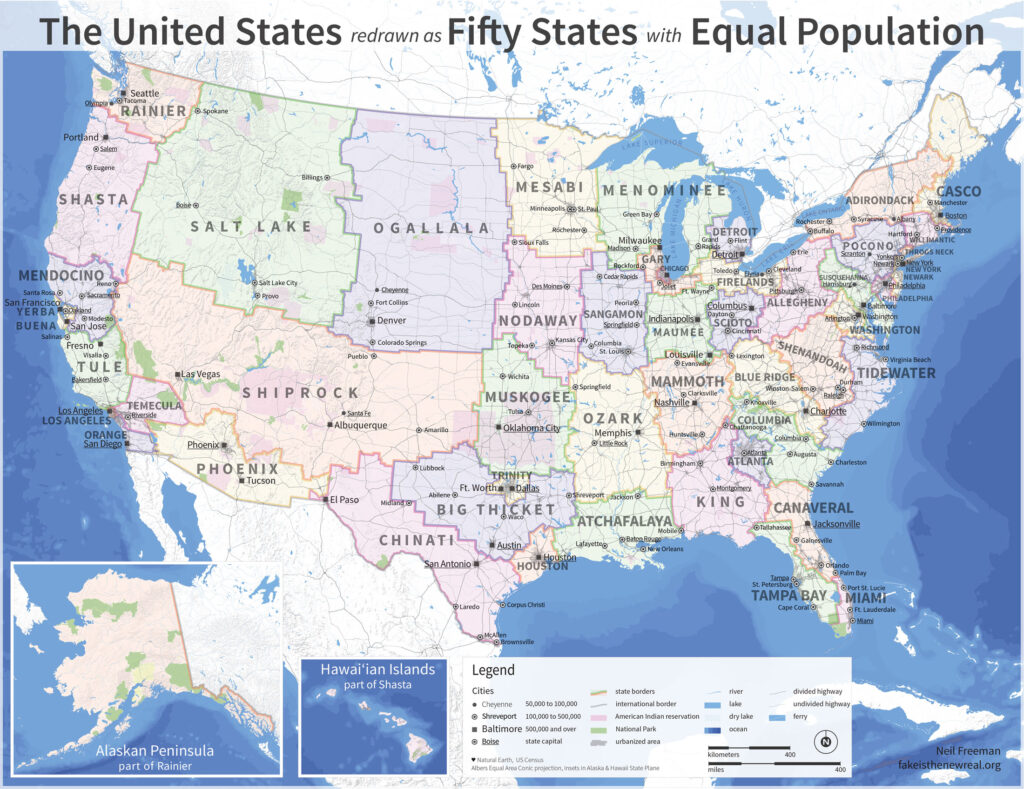
See also: Neil’s 50 states and 50 metros
The fifty largest metro areas, disaggregated from their states. Each has been scaled and sorted according to population.
-
Interview with Josh On
The creator of They Rule was interviewed in 2004:
The way we are going to move forward in social movements is less around art-pranks and more on good social organizing with one another in real life … organizing places where people can come together to debate ideas.
-
Doonesbury’s War
A profile of Garry Trudeau, whose story of B.D.—the national reservist amputee—has given Doonesbury a relevance you don’t often find in comics.